Me, we, they: identifying the key stressors affecting the dental team
Completed survey responses were received from 1,507 respondents, which included 287 valid free-text responses. The qualitative sample included a wide range of team members: 203 dentists, 69 dental care professionals (DCPs), 13 practice managers/receptionists and two undeclared.
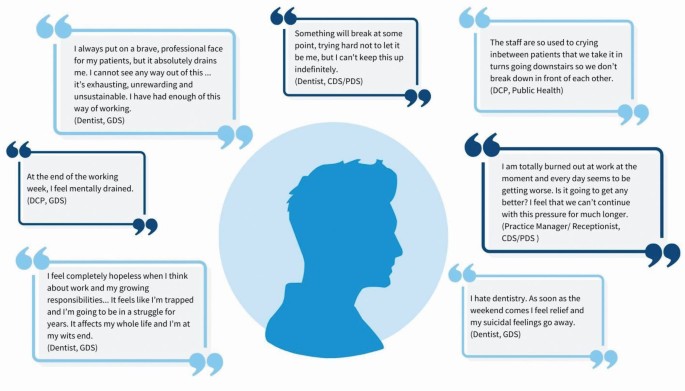
The aim of this study was to identify and explore the factors that contribute to stress and burnout within the dental team. However, before presenting the results of the thematic analysis, we feel it is important to actively acknowledge and forefront the depth of despair which exists within some members of the dental profession. The extracts shown in Figure 1 illustrate the level of mental distress and despondency which some dental team members are currently experiencing.

Quotes from respondents revealing depths of despair
Several respondents expressed a negative view of dentistry as a career, with some actively discouraging young people not to join the profession (Fig. 2).

Quotes from respondents about recommending a career in dentistry
Key stressors
Six themes were identified from the data: workload; NHS system; regulatory compliance, patient complaints and litigation; financial pressures; leadership and management; and self-worth.
Workload
Respondents frequently referred to an intolerable workload, which was described as steadily increasing with little sign of respite:
-
‘Patient numbers and demand are much higher than dentists are now able to cope with and it’s affecting all levels of staff, from reception to surgery’ (DCP, GDS independent).
Demand for services continued to rise, which led to long waiting times and additional pressure and stress on staff:
-
‘The demands on service are overwhelming. Pre-COVID, I worked 2-3 weeks ahead…I am now booked three months ahead. This has led to an incredibly stressful work environment’ (dentist, GDS independent).
Issues around recruitment and retention, particularly in the NHS, placed additional pressure on remaining staff, causing further frustration and stress on all members of the dental team:
-
‘We are massively short-staffed (50% of normal staffing currently at my own clinic) but the volume of work remains the same, so the pressure on staff increases’ (dentist, CDS/PDS).
NHS system
Working within the NHS was considered particularly stressful. The increasing demands on services, coupled to reduced capacity, was seen as a major contributing factor in stress and burnout:
-
‘The greatest stress frustration comes from high volumes of patients seen at an NHS practice and providing work to a quality I would like while working towards NHS UDA [units of dental activity] targets’ (dentist, GDS independent).
Criticism of the NHS was universal, despite different contractual systems being adopted across each of the four UK countries. In England, the UDA was widely criticised, with frustration at the delays in implementing contract reform, which undermined any hope that change was imminent:
-
‘Feel under constant pressure and stress from NHS unachievable targets…[the] Government [is] not bothered or committed to funding so [it] seems [there is] no positive future for NHS dentistry’ (dentist, GDS independent).
Disaffection with the NHS was a key driver towards a shift to the private sector, which was considered to offer a better working environment, less stress and greater autonomy:
-
‘I now work privately with children’s NHS only. There is less pressure, less complaints and I am less stressed’ (dentist, GDS corporate).
Regulatory compliance, patient complaints and litigation
Increasing levels of regulation, with a constant fear of complaints, litigation, or referral to the General Dental Council (GDC), were a recurring theme in relation to stress. There was widespread resentment at the time and effort required to demonstrate regulatory compliance, much of which was considered unnecessary:
-
‘The increasing nonsense regulations that don’t improve patient care one bit that we all pretend to follow and the increasing complaint culture has sucked the fun out of dentistry’ (dentist, GDS independent).
Regulatory bodies, such as the GDC or Care Quality Commission, were frequently referenced as being overzealous and unsympathetic, and viewed as responsible for creating a climate of fear which caused considerable stress:
-
‘The atmosphere from regulatory bodies, constant fear of disciplinaries, constant litigation fear and the feeling of being held to ransom by patients with axes to grind’ (dentist, GDS corporate).
Patient complaints were considered one of the greatest stressors and appeared to be a constant worry for many:
Respondents reported a significant increase in the number of complaints and felt this had escalated since the COVID-19 pandemic:
-
‘We have verbal complaints daily about appt [appointment] waiting times and written complaints have increased 200%! Prior to COVID we could go years without a written complaint’ (practice manager/receptionist, GDS independent)
Part of the reason for a rise in complaints was reported to be a shift in patient expectations, which were often deemed to be unrealistic, particularly within the NHS:
-
‘I have always enjoyed my job but I feel patients are more angry, frustrated and worried than before and we seem to get much more moaning and complaints directed at us. We have worked tirelessly to try and catch up (while being short of staff and a dentist) but can’t meet all patient expectations within an NHS system that is not fit for purpose now’ (dentist, GDS corporate).
Strong views were expressed that delivering care to patients with high expectations, under NHS contractual arrangements with the overriding threat of regulatory non-compliance, created a difficult and stressful environment:
-
‘It’s not patients or patients’ expectations that keep us up at night. It’s the fear of the reprisals that could come as a result of us not meeting what are essentially unrealistic expectations placed on us by the state and the patients’ (dentist, GDS independent).
Complaints were a major stressor for all members of the dental team, but it was acknowledged that practice managers and receptionists were often the team members who had to deal directly with disgruntled patients:
-
‘It is practice managers and reception staff that are taking the brunt from patients’ dissatisfaction, frustration and fear’ (practice manager/receptionist, GDS corporate).
For dentists, the underlying worry from a complaint was the risk that it may escalate and lead to litigation or referral to the GDC, and this was referenced by multiple respondents:
-
‘Currently, threats of litigation and GDC referral terrify and isolate most GDPs [general dental practitioners] just trying to do their jobs’ (dentist, GDS corporate).
Although an issue for all dental care professionals, litigation and referral to the GDC appeared to cause the greatest concern among dentists working in general dental services.
Financial pressures
Although dentistry can be professionally and financially rewarding for dentists, financial pressure, particularly when linked to NHS performance targets, was highlighted as a major cause of stress:
-
‘The stress of meeting targets and UDAs led me to leave a self-employed mixed practice for a salaried post where I don’t have to worry about how much money I’m going to bring home each month. I also don’t have to feel like I have to rush patients and cut corners’ (dentist, CDS/PDS).
While some had left the NHS (GDS) to work in the salaried service, others had left to work in the private sector. Others expressed a desire to leave dentistry altogether but felt trapped due to their own financial obligations:
Financial pressures, poor pay and feelings of being undervalued were frequently expressed by DCPs who were frustrated and resentful at how hard they had to work, while being poorly remunerated compared to many other occupations:
Leadership and management
Many of the respondents cited frustration towards management at a practice or organisational level, which they felt contributed to the stress of the job:
-
‘I love my job and I am good at it. However, management is awful. No interest in staff. My job doesn’t stress me. Management do!’ (DCP, schools and nurseries).
This stress appeared to be related to a variety of issues, including lack of support and guidance, or due to perceived unfairness or inequality within the team:
-
‘There is huge lack of support and guidance in my post. The right things are said but never put into practice and I can say this with certainty as I have worked in post for many years’ (DCP, CDS/PDS).
Although corporates were mentioned in relation to poor management, respondents were equally critical about principals within independent dental practices who failed to appreciate staff or associates:
-
‘I was a mixed NHS/private, high-grossing associate, people pleaser, did everything in practice, but felt unappreciated by principal’ (dentist, CDS/PDS).
This was often closely aligned to poor organisational leadership, irrespective of the setting. If the team was not well led and functioning properly, members of the team were increasingly stressed and unhappy in their work:
-
‘I feel there is a total lack of effective leadership in the workplace…I’m well aware we all have a role to play in the management of our service delivery but there has to be a hierarchy of leadership overseeing services, with tasks delegated appropriately according to scope of practice and experience’ (DCP, hospital).
Self-worth
A consistent theme throughout the data was the importance of feeling valued and appreciated at work. Some of this was related to external factors, such as remuneration, respect, gratitude, teamwork, good management and professional fulfilment. When respondents felt undervalued or underappreciated in their role, they felt unhappy, stressed and unfulfilled:
For dentists, the frustration was often attributed to the system, in particular, the NHS:
For DCPs, the frustration was more often centred on the organisation, where they felt taken for granted and underappreciated:
-
‘Without the dental nurses, the whole practice could not function and I believe the dental nurses need the most support for their mental health, as they are the least paid but do most of the essential day-to-day jobs needed to run the practice’ (DCP, GDS corporate).
Some struggled with a constant feeling of failure as they felt they had been unable to deliver the care their patients needed:
Others felt trapped, or unable to escape:
While others grappled with self-doubt:
-
‘Every day working in the dental industry is draining, burning me out and making me question my ability to do my job’ (DCP, GDS corporate).
The importance of support was identified by several, and this was underlined by the various comments about loneliness and isolation:
As previously highlighted, management had an important role in promoting teamwork and ensuring that individuals felt valued as members of the team. When this was not the case, individuals felt isolated and worthless:
-
‘I feel like I am alone, with no support…there is no motivation for a GDP working for the NHS to give more than necessary, as there is very low, if any, recognition…from the practices’ (dentist, GDS corporate).
link