The role of salivary biochemical markers and dental indices in the assessment of oral health of Egyptian children with cystic fibrosis: an exploratory study
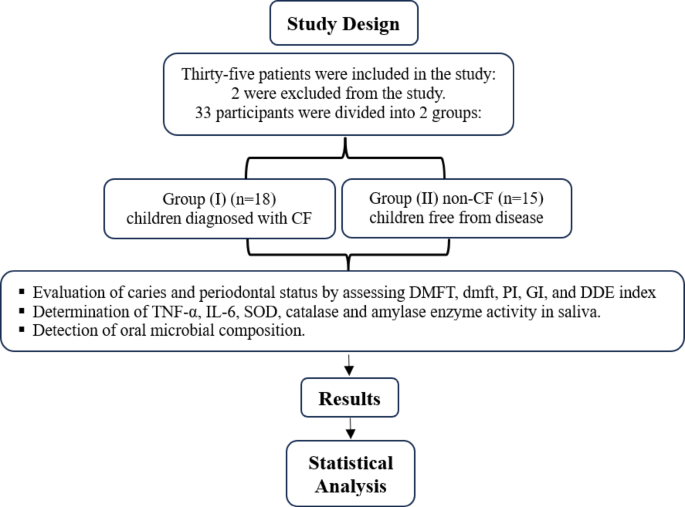
The impact of cystic fibrosis as a systemic disease on pediatric oral health has been studied in several previous reports17,18,19. However, the comprehensive view in the assessment of the oral and dental status for children with CF still seems modest. In the current study, we integrated more than one approach for accurate interpretation and evaluation of the oral/dental status in children with CF, including: dental indices measurement, salivary biomarkers determination, and consideration of diet/medication. Through measuring dental indices and determining salivary biochemical markers, our results suggest that daily diet and the routinely used medication regimen might inadvertently prevent children with CF from the onset of oral and dental alterations.
Dental indices are the most commonly used tools to quantify oral and dental diseases, allowing the interpretation of disease severity and treatment efficacy20. Regarding dental caries, although controversial information was detected in other studies in children with CF9,17, our results confirm, in agreement with the majority of researches that dental caries prevalence is fairly similar in both primary and mixed dentition, as illustrated by a non-significant difference in dmft and DMFT indices; (p = 0.366 and p = 0.055 respectively) when CF and non-CF children were compared. The periodontal health of children with CF was also discussed in other previously published articles, showing another controversy regarding this aspect11,21. In our study, we did not record a significant difference in PI index between the CF and non-CF children (p = 0.526), indicating that the amount and location of plaque are rather equal in both groups. On the other hand, we recorded an unexpectedly significantly lower score in the GI index in the CF children group in comparison to non-CF counterparts (p = 0.003), indicating a lower prevalence of gingival inflammation signs, including either color change, swelling, bleeding, or ulceration. The literature shows distinct variation in the enamel abnormalities among children with CF. In a review article, Pawlaczyk-Kamieńska T et al. 2019 reported three studies illustrating different results regarding tooth enamel abnormalities. Of the three studies, two showed a non-significant difference in DDE index between CF and non-CF children, whereas the third study recorded a significantly higher prevalence of enamel defects in CF children21. In total, our results didn’t record a statistically significant difference in DDE index categories, including normal enamel, demarcated opacity, diffuse opacity, and hypoplasia between the CF and non-CF children (p = 0.526).
Salivary biochemical markers play a crucial role in evaluating oral/dental as well as systemic conditions. They are frequently linked to caries, periodontal disease, and oral cancer, as well as diabetes and cardiovascular diseases22. In this study, we selected a panel of biochemical markers, including α-amylase, superoxide dismutase, catalase, IL-6, and TNF-α. The α-amylase is a digestive enzyme that represents a highly rich component of saliva. It contributes to the development of caries due to its ability to break down carbohydrates into disaccharides and short-chain oligosaccharides23. Our results showed a highly significant increase in α-amylase activity level in CF children in comparison to non-CF children. Although the impact of cystic fibrosis, as a disease, on α-amylase activity is actually beyond the scope of this article, it is worth noting that two old publications recorded an increased level of the enzyme activity in CF patients24,25, while decreased levels were reported by a recent study26. Since increased α-amylase activity is frequently correlated with increased occurrence of dental caries27, it was predicted that this significant increase would be accompanied by high caries index scores, but unexpectedly, this did not occur. This contradiction could be attributed to the low-carbohydrate diet, which permits only a small amount of carbohydrate to be exposed to the digestive enzyme action. Furthermore, frequent use of antibiotics for recurrent respiratory infections reduces the risk of dental caries development by inhibiting the growth of cariogenic bacteria.
Saliva contains several biochemical markers that can detect oxidative stress and inflammation at the molecular level, thereby enabling the prediction of periodontal disease during its early stages28. For this purpose, we used a panel of markers consisting of two antioxidant enzymes and two proinflammatory cytokines to be estimated in the saliva of both CF and non-CF children. Our results revealed that the activity levels of superoxide dismutase (SOD) and catalase in saliva, which act to prevent ROS accumulation and periodontium damage, were significantly lower in CF children in comparison to non-CF children, p = 0.027 and p < 0.001, respectively. Such decreased activities would be expected to stimulate a state of oxidative stress in the oral cavity, paving the way for the occurrence of different periodontal diseases. Furthermore, the oxidative damage to oral tissues is a pivotal event that ultimately leads to the development of chronic inflammatory disorders28. In agreement with the previous fact, our study recorded a highly significant increase in the pro-inflammatory cytokines, IL-6 and TNF-α levels in the saliva of CF children in comparison to non-CF children, p < 0.001. Strikingly, our study didn’t reveal any statistically significant signs of periodontal disease as indicated by PI and GI index scores. Considering the anti-inflammatory effect of the daily routine oral medication regimen, including nebulizers, bronchodilators, and corticosteroids, such medications most probably provided a continuous alleviative effect counterbalancing the inflammatory effects exerted by the systemic disease in CF children. However, long-term use of such medications has been reported to reduce adverse effects on adults’ oral health29.
Cystic fibrosis primarily affects the lungs and respiratory airways, resulting in thick, sticky mucus formation, providing a suitable environment for various types of bacterial growth30. Our results revealed that bacteria that impact CF children’s respiratory health, including Klebsiella spp., Streptococcus spp., Pseudomonas spp., and Moraxella catarrhalis, are not only colonized in the mucous but also in dental plaques and caries. Therefore, dental plaques must also be considered a specific reservoir for bacterial colonization, as well, which undoubtedly worsens the condition. Our study strongly recommends the use of oral hygiene to scavenge bacteria colonized in plaque and caries, preventing recurrent respiratory infections. Additionally, it warns from the long-term use of nebulizers, bronchodilators, and corticosteroids to prevent periodontal alterations in the adult stage.
In conclusion, the current study illustrates that the effect of cystic fibrosis-linked systemic oxidative stress and inflammation is extended to the oral cavity, as indicated by the significantly decreased salivary antioxidant enzyme activity levels, including SOD and catalase, and the significantly increased levels of salivary proinflammatory cytokine levels, including TNF-α and IL-6, in our CF children. Although systemic oral oxidative stress and inflammation have been reported to be accompanied by oral/periodontal disorders, periodontal index scores of our CF children, including PI and GI, revealed a non-significant difference, suggesting a mitigating role of the daily routine medication regimen, which is known to exert antioxidant and anti-inflammatory effects. However, as reported, this beneficial effect can be reversed by long-term use of these medications. Furthermore, the significantly increased levels of salivary α-amylase activity were not accompanied by dental caries as indicated by the non-significant difference in dmft and DMFT caries index, drawing attention to the low-carbohydrate diet, which masks the effect of the high salivary α-amylase activity levels.
link